
Forging
Forging Background Information
Forging is a manufacturing process involving the shaping of metal using localized compressive forces. The blows are delivered with a hammer (often a power hammer) or a die. Forging is often classified according to the temperature at which it is performed: cold forging (a type of cold working), warm forging or hot forging (a type of hot working). For the latter two, the metal is heated, usually in a forge. Forged parts can range in weight from less than a kilogram to hundreds of metric tons. Forging has been done by smiths for millennia; the traditional products were kitchenware, hardware, hand tools, edged weapons, cymbals and jewellery.
Since the Industrial Revolution, forged parts are widely used in mechanisms and machines wherever a component requires high strength; such forgings usually require further processing (such as machining) to achieve a finished part. Today, forging is a major worldwide industry.
Forging Manufacturing Process Step Explanation
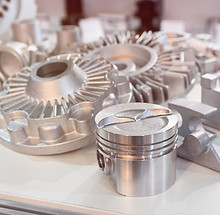


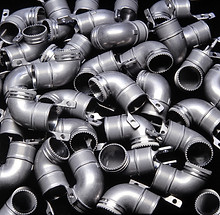


1. Tool Development
The first step involves designing and building a metal die from special grades of steel. The die can be made as a simple one cavity tool or a complex multi-cavity tool depending on component geometry and volume requirements.
2. Bar Cutting
Raw Material billet, ingot or bar will be cut as per the calculation based on the part geometry where proper chopping process is required to match exact near & net shape of the expected component as per print where it will cut in proper length & weight based fundamentals.
3. Bar Machining
The desired length & weight cut piece of bar or billet is required machining like diameter or outer profile or chamfering process where the high quality level parts without any hairline impression can be manufacture so at that time the process is helpful.
4. Bar Heating
The cut piece is ready for next process like bar or billet heating where the cut piece will be in red hot condition with desired temperature where it can be easily take almost net & near shape of the part without any non-fill area or defects so the process of bar heating is most important factor.
5. Forging
This process is done through the so-called “flash.” Heat-treated steel bars or billet that have been placed under lower and upper dies and then pressed into the desired shape after being heated from billets with proper desired strokes onto the heated cut piece where the part will take net shape of the component.
6. Trimming
Now that forging blanks with flash have been acquired, the flash will be removed by pressing the steel blanks once more while being placed under trimming dies. A complete forging blank is finished in this step where there will be parting line impression from the trimming area in component.
7. Grinding
Forged component after trimming process where the parting line impression will come so grinding operation will be perform to make a smooth finish of parting line of other required area in the component where aesthetic look can be improve.
8. Fettling
Parts will be done final finishing with pneumatic tools on parting line system or other area with near and net shape matching of the exact forge part then it will be done shot blasting or ceramic blasting as per the material specification or process selection of fettling stage.
9. Heat Treatment
The purpose of heat treatment is to change a mechanical property or combination of mechanical properties so that the metal will be more useful, serviceable, and safe for a definite purpose. By heat treating, a metal can be made harder, stronger, and more resistant to impact, heat treatment can also make a metal softer and more ductile.
10. Proof Machining
In some case the components will be supply with proof machining or semi finished condition where the maximum over all machining operations like CNC or VMC or HMC or VTL or SPM so the final machining with proper exact location or proof machining helpful for getting accuracy.
11. Machining
Various machining techniques are then employed including CNC or VMC or HMC or VTL or SPM to achieve the final surface finish & dimensions needed to more important with function,fitment & application area point of view then after with all quality checks.
12. Shipment
Parts will be done with standard or customised packaging system to make a shipment on desired location by customer, From the beginning level incoterms has been already set for the goods despatch and clearance of the shipment with particular system & process.
Forging Advantages
-
High part soundness
-
Reliability
-
Repeatability
-
Structural integrity
-
Cost effective than casting
-
High ductility
-
Mass production feasibility
Forging Disadvantages
-
Tool cost quite expensive
-
Post machining operations
-
Difficult to maintain close tolerance