
Investment Casting
Investment Casting Background Information
Investment casting is an industrial process based on lost-wax casting, one of the oldest known metal-forming techniques. The term "lost-wax casting" can also refer to modern investment casting processes.
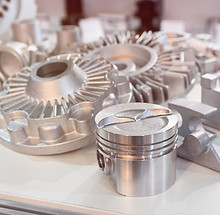
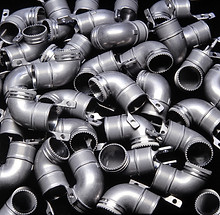
Investment casting has been used in various forms for the last 5,000 years. In its earliest forms, beeswax was used to form patterns necessary for the casting process. Today, more advanced waxes,refractory materials and specialist alloys are typically used for making patterns. Investment casting is valued for its ability to produce components with accuracy, repeatability, versatility and integrity in a variety of metals and highperformance alloys.
Investment Casting Manufacturing Process Step Explanation






1. Casting Simulation
Main objective of using computer-aided casting design and simulation software to casting process is to offer maximum data on casting quality by predicting solidification occurrences and associated features which can be helpful to get an optimum level cast part soundness with maximum defect free component.
2. Tool Development
The first step involves designing and building a metal die from Aluminium. This die creates a wax replica of the desired part by injecting melted wax under high pressure into the cavity. The die can be made as a simple one cavity manual tool or a complex multicavity automatic tool depending on volume requirements.
3. Wax Pattern Injection
Pattern wax will be used in hydraulic manual, semi or automatic injection press machine to fill the die or tool mirror cavity through the wax so desired metal part same copy wax part will be inject along with inbuilt gating or feeding system.
4. Wax Pattern Assembly
The wax patterns are assembled onto vertical or horizontal runner or base and into a finished tree with the help of sticky wax, Assembly tree can be single part per assembly or multiple part per assembly depends on part weight & area as per geometry.
5. Ceramic Shelling
The assembly is then dipped into a high-grade ceramic slurry to build a ceramic shell around the wax tree. After the slurry coating is done, particles of sand are dropped onto the surface of the wet tree assembly. This helps to thicken and strengthen the layer of coating on the wax assembly surface. Repeat steps of further backup coating until the assembly achieves the desired shell thickness. The assembly is then allowed to set and dry.
6. Shell Dewaxing
The wax inside the newly built shell is now removed so the ceramic covered shell outer wax tree will be with hollow mirror cavity of the cast parts. Dewaxing is done using a steam-dewaxing autoclave or flash fire furnace.
7. Shell Firing
To burn the residual wax from the ceramic shell cavity and to strengthen then ceramic shell up to high temperature withstanding capacity these shells are backed or fired in shell backing or continuous firing furnace.
8. Pouring
After batch sample satisfactory report of liquid metal prepared in furnace the metal is ready for pouring. Now the desired molten metal is poured into the pre-heated mould cavity.
9. Knockout & Cutting
Invested ceramic outer the wax assembly tree will re removed from the metal poured shells which called knockout process and from metallic assembly shell individual parts will be cutting from gating or feeding system.
10. Heat Treatment
The purpose of heat treatment is to change a mechanical property or combination of mechanical properties so that the metal will be more useful, serviceable, and safe for a definite purpose. By heat treating, a metal can be made harder, stronger, and more resistant to impact, heat treatment can also make a metal softer and more ductile.
11. Fettling
Parts will be grind on gating or feeding system with near and net shape matching of the exact cast part then it will be done shot blasting or ceramic blasting as per the material specification or process selection of fettling stage.
12. Machining & Shipment
Various machining techniques are then employed including CNC or VMC or HMC or VTL or SPM to achieve the final surface finish & dimensions needed to more important with function, fitment & application area point of view then after with all quality checks & approval parts will be done with standard or customised packaging system to make a shipment on desired location by customer
Investment Casting Advantages
-
Affordable tooling development cost
-
Excellent surface finish
-
High dimensional accuracy
-
Extremely intricate parts are castable
-
Almost any metal can be cast
-
No flash or parting lines
-
Effective utilization of metal
Investment Casting Disadvantages
-
Difficult to cast objects requiring cores
-
Longer production cycles compared to other casting processes
-
Quite expensive